In brief
- Access means people can use a tool. Adoption means one real workflow has a named owner, human review, an exception route, and a way to observe whether it helps.
- Transformation is not a premium label for adoption. It becomes relevant only when several workflows, roles, decision rights, information flows, and governance conditions must change together.
- SE Ocean starts with the smallest responsible scope: read one live decision when the situation is unclear; test a bounded workflow when it is ready; diagnose the system only when cross-system change is evidenced.
The terms are not a maturity ladder
The market uses AI adoption and AI transformation in many ways. That makes the labels easy to sell and hard to use. An organization can have thousands of licenses and no reliable adoption. It can also have one carefully designed workflow that creates real value without needing a company-wide transformation.
The useful distinction is not which label sounds more ambitious. It is the scope of change that the work actually requires. Start with the smallest scope that can carry the decision safely, then go deeper only when the evidence asks for it.
Access, adoption, and transformation answer different questions
Separating these three states prevents a common mistake: treating a tool rollout as proof that the organization has changed, or treating every difficult workflow as proof that a transformation programme is necessary.
| State | What is true | Question to answer next |
|---|---|---|
| Access | People have a license, tool, prompt library, or introductory training. | What work should this tool help people do better, and what must remain human? |
| AI adoption | A defined group can operate one workflow with an owner, review rule, exception route, and operating measure. | Can this workflow remain useful, accountable, and safe in real conditions? |
| AI transformation | Several roles, workflows, decision rights, information flows, and governance conditions need to change together. | Which cross-system changes are truly required, and in what sequence? |
Adoption begins in one real workflow
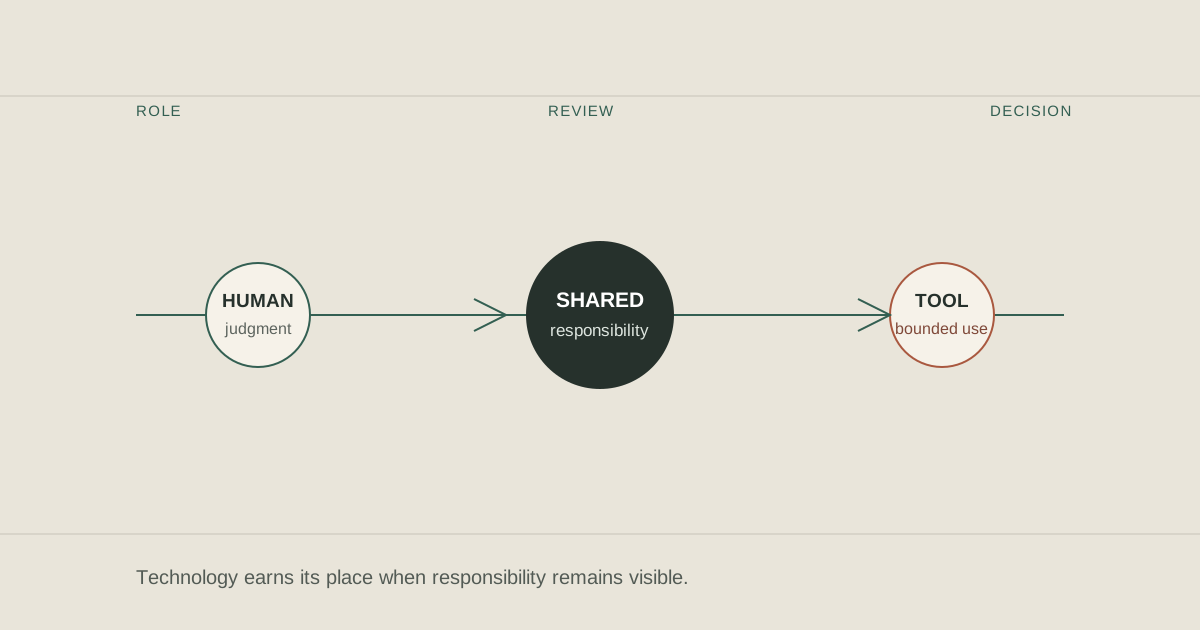
A team has not adopted AI because it attended training or opened an account. Adoption begins when the people doing a real piece of work can explain when to use the tool, when not to use it, who remains responsible for the outcome, what must be reviewed, and where an exception goes.
This is why usage alone is a weak signal. People can log in because they are asked to, then quietly avoid the tool when quality, customer impact, or accountability becomes unclear. Non-use and workarounds are not proof of resistance. They may be evidence that the operating conditions are still incomplete.
- One bounded workflow and a named decision owner
- A clear use and non-use boundary
- Human review that has time, context, and authority to matter
- An exception route for cases that do not fit the normal rule
- A measure of operating value, quality, rework, or risk—not only logins
Transformation begins when the workflow exposes the system around it
A single workflow can reveal that the problem is wider. Perhaps customer-facing staff cannot use an AI assistant safely because data ownership is unclear. Perhaps the output changes what a manager can approve, how legal review enters the work, which team owns knowledge, or what quality means across functions.
That does not automatically mean the organization needs an AI transformation programme. It means there is a cross-system question to inspect. Transformation becomes a responsible description when several interdependent operating conditions must change together—not when a tool vendor needs a larger scope.
People are not an obstacle to work around
Employees often ask a reasonable question that a rollout plan has not answered: what happens to the standard of good work, to my judgment, and to my responsibility when this tool enters the workflow? If the answer is vague, concern may look like resistance even when people are trying to protect customers, quality, and their own accountability.
A responsible adoption conversation does not promise that people will never feel uncertainty. It makes the changed role credible: what the technology is for, what remains human, when a person can disagree or escalate, and how capability will be built without treating someone as replaceable by default.
Where SE Ocean enters—and where it does not
If the live question is still unclear or contested, Problem First Read helps a decision owner separate visible symptoms, hypotheses, missing evidence, and the responsible next decision. It does not diagnose the whole organization or sell a transformation by default.
When one workflow is ready to test, SE Ocean can help design the operating experiment and, when capability is the actual constraint, facilitate an Applied Adoption Lab using the client’s real work. When multiple systems must change together, the route is System Diagnostic, then System Architecture and implementation stewardship only where evidence supports that depth.
SE Ocean does not resell AI tools, build an entire platform alone, take decision authority from leaders, or promise employee adoption through a workshop. Technical, legal, security, data, and HR specialists remain essential partners in their own domains.
Continue exploring
Take the next question to the right place.
Sources
Read the primary sources
Continue at the pace your decision needs
You do not need to contact us yet. Start with the question closest to what is happening.
When a real decision is live, share the situation and SE Ocean can assess the responsible starting point.
Related questions
Is AI access the same as AI adoption?
No. Access means people can use a tool. Adoption means a defined workflow can operate with a responsible owner, meaningful human review, an exception path, and a way to observe whether the tool improves the work.
Does every AI pilot need an AI transformation programme?
No. A bounded pilot may be the responsible answer. Broader transformation is warranted only when evidence shows that several roles, decision rights, information flows, workflows, and governance conditions need to change together.
How can we introduce AI without making employees feel replaceable?
Start with a real piece of work and make the changed role credible: state what the tool is for, what remains human, who reviews, how exceptions are handled, and how people will build the capability to work differently. Do not frame concern as resistance before hearing what risk or responsibility is unresolved.