In brief
- A change can be urgent without the explanation behind it being complete. Clarifying the decision is not delay; it is how an organization avoids paying twice for the same unresolved tension.
- Before hiring, restructuring, adding approval, or buying a system, name the relief the change is expected to create, the load it may move, and the evidence that could prove the story wrong.
- The next responsible move may be to proceed, test a smaller intervention, reduce scope, or inspect one live decision before committing more people and money.
A change can feel obvious before its story is complete
When the work is strained, a solution can arrive with the force of common sense: hire someone, redraw the organisation chart, add an approval, or buy a system. The pressure is real. Someone is overloaded, customers are waiting, errors are becoming visible, or a leader is carrying too much risk.
The risk is not that change is always wrong. It is that a useful change is asked to solve a problem it has not actually been designed to relieve. That is how an organisation adds cost, meetings, and handoffs, then discovers that the original tension has merely moved to another person or team.
Ask what the change is expected to relieve
Before deciding whether a change is necessary, make the expectation testable. A clear decision does not need certainty. It needs a shared account of the condition that should become better and the consequence the organisation is prepared to carry.
- Expected relief: What specific delay, risk, rework, or decision burden should become lighter?
- Displaced load: Whose work, authority, review time, or customer risk will increase if this change works as intended?
- Missing evidence: What would make us revise the explanation before committing further?
A small approval change can move the problem rather than solve it
Imagine an organisation has seen several costly errors. Adding an approval step may seem responsible. It can reduce one visible error, but it can also slow decisions, make a manager the default bottleneck, and encourage people to wait rather than resolve a case at the point where they have the best context.
The question is not whether approval is good or bad. It is whether the error came from a missing check, unclear authority, weak information, an exception with no route, or an acceptance condition nobody could apply. Each explanation asks for a different intervention.
| Visible pressure | Change that feels obvious | Question to test first |
|---|---|---|
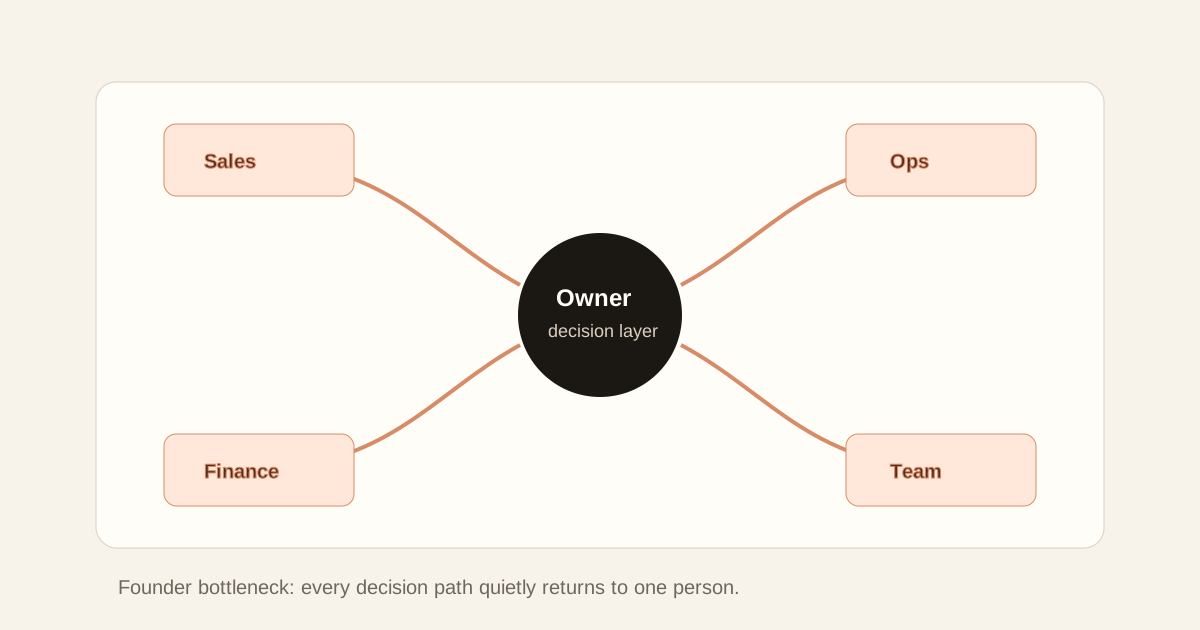
| One leader is overloaded | Hire another manager | Is the load a volume problem, or do critical decisions still have no landing place? |
| Errors are visible | Add an approval | Which decision, evidence, or exception is actually failing? |
| Teams keep disagreeing | Redraw reporting lines | What trade-off has no owner across the current handoff? |
Urgency does not remove the need for judgment
Some decisions cannot wait. A safety risk, financial exposure, or critical customer failure may require action now. Even then, the organisation can state what is known, what is assumed, and what it will watch after the change. This makes the decision more responsible, not less decisive.
Do not turn this into a ritual of indefinite analysis. If the evidence is sufficient, proceed. If it is not, reduce the first move to something observable and reversible where possible. The aim is not to avoid change. It is to stop an incomplete explanation from becoming an expensive architecture.
Start with one live decision, not a promise to solve the organisation
If a consequential change is approaching and the story beneath it still feels contested, start by reading one decision in its real context. A Problem First Read separates what is visible, what may be producing it, what the current evidence cannot yet prove, and which next decision is proportionate.
It does not decide for the leader or commit the organisation to a larger engagement. The decision remains the client’s. The work is to make the conditions and consequences clearer before they become harder to reverse.
Continue exploring
Take the next question to the right place.
Continue at the pace your decision needs
You do not need to contact us yet. Start with the question closest to what is happening.
When a real decision is live, share the situation and SE Ocean can assess the responsible starting point.
Related questions
Should we delay a restructure until we have perfect evidence?
No. Perfect evidence is rarely available. The responsible move is to state what the change is expected to relieve, what it may displace, and what you will observe after acting. Urgent decisions can still be explicit about uncertainty.
Will hiring solve an overloaded leader problem?
It can solve a genuine capacity gap. It will not solve a decision-right or exception problem unless the new role has the information, authority, and acceptance conditions needed to carry the work.
What does SE Ocean provide before a major organisational change?
Problem First Read provides a bounded written reading of one live problem or decision: visible symptoms, hypotheses, supporting and missing evidence, unresolved questions, and a proportionate next decision. It is not a claim to diagnose the whole organisation in one session.