In brief
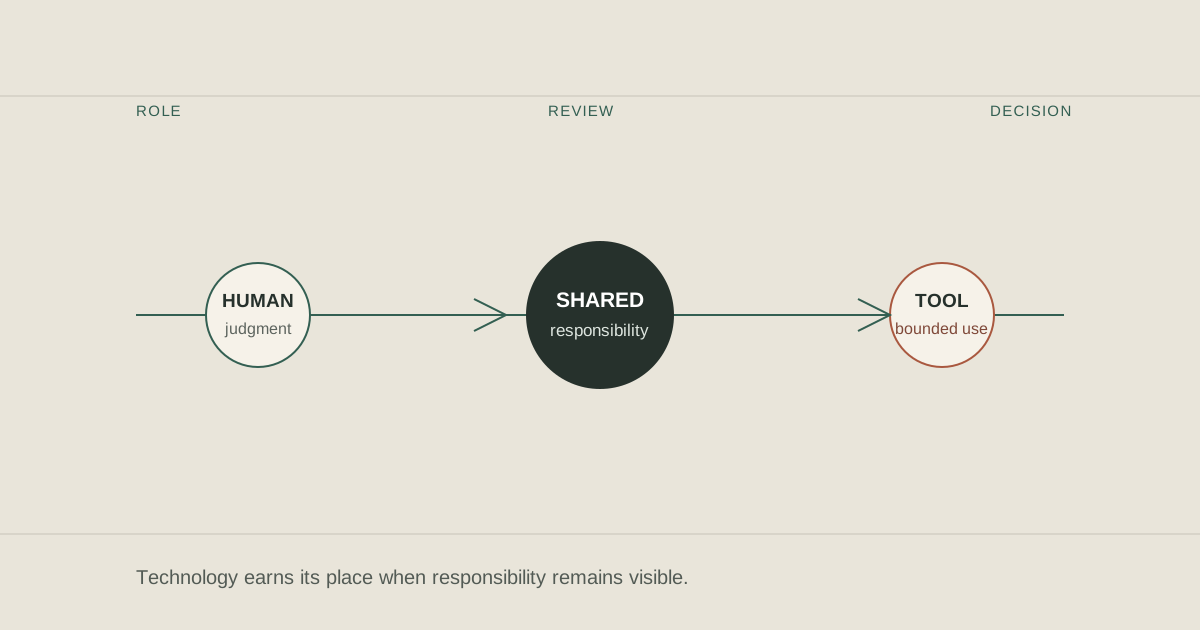
- AI does not remove accountability; it makes unclear accountability more consequential because work can travel faster and appear more credible.
- Before deploying an AI workflow, define the decision being supported, the human owner, the information boundary, the exception route, and the condition for accepting the result.
- The safest first use cases are bounded, reviewable, and reversible. High-impact decisions need a clear human authority rather than a vague promise of oversight.
AI changes the speed of a decision, not who should own it
AI adoption fails when an organization treats a system output as if it were a decision owner. A model can summarize, classify, draft, recommend, or route work. It cannot hold the business, legal, customer, or human consequences of acting on its output.
When accountability is undefined, the team often discovers the gap only after an error. People assume someone else reviewed the output, an exception has no path, or an automated recommendation becomes the default simply because it arrived quickly. The system then amplifies ambiguity rather than reducing it.
Define five boundaries before an AI workflow goes live
A useful governance conversation is concrete. It does not begin with an abstract policy about responsible AI. It begins with one workflow and the conditions under which an output can influence a real decision.
- Decision boundary: what decision is the workflow informing, and what is it never allowed to decide?
- Accountable owner: which named role accepts the outcome and can stop the workflow?
- Information boundary: what data is permitted, sensitive, uncertain, or excluded?
- Exception boundary: what signals a case that needs human judgment or escalation?
- Acceptance boundary: what evidence must be present before the output is acted on?
A practical example: an AI assistant for customer-response drafts
An AI assistant that drafts customer responses can be a sensible first use case. The task is bounded, a human can review the result, and the action is reversible before sending. But the workflow still needs rules: which product claims may appear, which customer signals require escalation, who can approve an exception, and how feedback changes the prompt or knowledge source.
Without those rules, the team may gain speed while quietly losing control of tone, promises, and customer commitments. The relevant measure is not only drafting time. It is whether the organization can explain why a response was sent and who was accountable for its content.
| Weak control | Why it fails | Accountable control |
|---|---|---|
| A human is in the loop | No one knows when review is required | Named reviewer plus clear escalation triggers |
| The model uses approved data | No boundary for sensitive or stale information | Allowed sources, exclusions, and update owner |
| We monitor quality | Quality has no acceptance condition | Defined checks before an output can act |
Start where human review can be meaningful
A strong first deployment gives people enough context and authority to disagree with the system. If a reviewer has no time, no access to the source information, or no right to stop the output, the review is ceremonial. That is not governance.
Choose a workflow where a human can inspect the output, understand the consequence, and change course. Capture exceptions as design evidence. The pattern of exceptions is often more valuable than the average accuracy score because it shows where the organization needs judgment, policy, or a different workflow.
Common mistakes in AI accountability
The recurring error is asking whether the model is capable before asking whether the organization is ready to carry its output. Capability matters, but the operating environment decides whether an AI workflow becomes useful, unsafe, or ignored.
- Deploying an assistant before naming the accountable business owner.
- Treating a generic review step as governance without clear review triggers.
- Measuring adoption while ignoring exceptions, reversals, and downstream harm.
- Giving an AI system access to information that no human role is accountable for governing.
Continue exploring
Take the next question to the right place.
Continue at the pace your decision needs
You do not need to contact us yet. Start with the question closest to what is happening.
When a real decision is live, share the situation and SE Ocean can assess the responsible starting point.
Related questions
What does AI accountability mean in an organization?
It means a named human role owns the decision affected by the AI workflow, can review or stop it, and is accountable for the rules, exceptions, and acceptance conditions around its outputs.
Can a human in the loop make an AI workflow safe?
Only if the human has enough context, time, authority, and a clear trigger for review. A generic approval step without those conditions is ceremonial rather than meaningful oversight.
Which AI use cases should an organization start with?
Start with bounded, reviewable, and reversible work such as drafting, retrieval, classification, or preparation. Avoid delegating high-impact decisions until accountability and exception routes are demonstrably clear.