In brief
- When work is delegated but consequential decisions return to one person, the issue may be the system around the decision—not the leader's willingness to let go or the team's effort.
- Trace what returns, the information that is missing, the authority that is unclear, and the consequence that makes people escalate before redesigning roles or adding management layers.
- The next step can be small: clarify one decision boundary, acceptance condition, and exception route. It does not have to become an organization-wide delegation programme.
Delegating work is not the same as delegating decision safety
A leader can be exhausted by decisions without being controlling, unable to delegate, or surrounded by incapable people. In many organizations, the work has already moved. Teams complete tasks, managers run meetings, and systems record status. What has not moved is the place where a difficult decision can safely land.
A consequential decision needs more than a named role. The person holding it needs enough information to understand the trade-off, authority to act, an acceptance condition that says when the work is good enough, and a route for exceptions that genuinely exceed their boundary. If one of these is absent, bringing the case back to the leader is often a rational form of risk control.
The lived pattern: everything important comes back
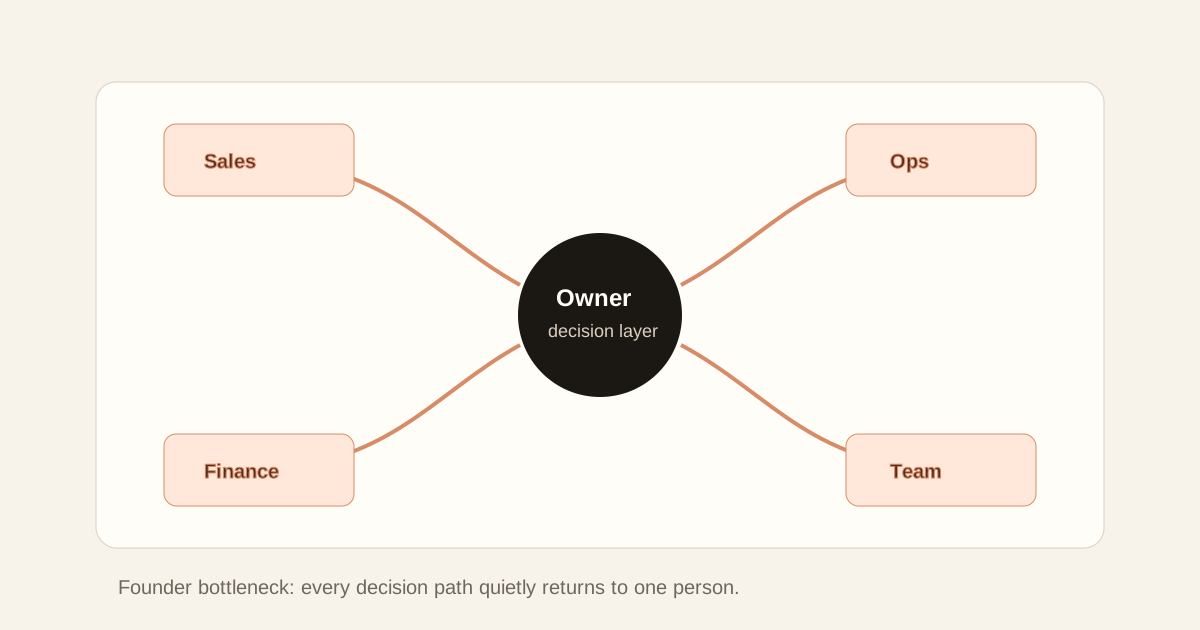
The pattern is familiar. A customer exception needs a promise. A delivery delay changes cost and priority. Two teams disagree about what counts as complete. A manager has a recommendation but asks the founder to confirm it. Each case looks different, yet the same person keeps translating, approving, or holding the risk.
This can look like a leadership problem because the leader is the visible bottleneck. But the useful question is not, ‘Why will nobody take ownership?’ It is, ‘What would a reasonable person need in order to take this decision without creating unacceptable risk for themselves, the customer, or the business?’
- Which decisions or exceptions return to the leader most often?
- What information is unavailable, inconsistent, or too late when others are asked to decide?
- What consequence makes the decision feel unsafe to hold elsewhere?
- What can a manager actually accept, change, or escalate without informal permission?
What the pattern may be showing
A decision-return loop often combines several tensions. Responsibility may sit with a manager while authority stays with the founder. The official workflow may have a handoff but no rule for the case that does not fit. Information may be available in separate tools but not assembled when the trade-off has to be made. Or the organization may never have agreed what outcome is acceptable without a senior override.
None of these tensions can be read reliably from an org chart alone. The chart can show reporting lines; it cannot show the message that quietly unlocks work, the person who checks whether a number is trustworthy, or the unspoken customer risk that causes a team to stop. Follow one real decision path before changing the structure around it.
| Visible response | What may still be missing | A smaller test |
|---|---|---|
| Tell the manager to decide | The decision threshold and acceptable risk | Name one decision boundary and the evidence needed to hold it |
| Hire a more senior operator | Authority, information, and an exception route | Test whether the new role can accept a real exception without founder confirmation |
| Add another approval step | A clear owner for the trade-off | Clarify who can accept which consequence before adding delay |
What it does not prove
This pattern does not prove that the leader should disappear from difficult decisions. Some choices properly remain with a founder, CEO, board, or designated executive. It does not prove that a team needs empowerment training, a reorganization, or a new operating model either.
It is evidence to inspect. The responsible next move depends on the decision's consequence, the facts available, and whether the current escalation is a necessary protection or an avoidable loop. Trying to solve the entire organization from this pattern alone would repeat the same mistake: acting before the system is clear enough to carry the change.
Begin with one decision, not a delegation programme
Choose one recurring decision that creates meaningful delay, rework, customer risk, or leader load. Describe the normal case, the evidence required, the person who should hold it, the condition that makes the outcome acceptable, and the exception that needs escalation. Then observe real cases long enough to see whether the decision travels differently.
The result may be a clearer decision right, a missing information owner, a revised exception rule, or a recognition that the leader should continue to hold this particular boundary. A good result is not measured by how much authority was pushed away from the founder. It is measured by whether the organization can make the right decision without creating unnecessary risk or hidden work.
When a focused review is useful
If one recurring decision, approval, or exception keeps returning to the leader, a Decision Bottleneck Review can map that flow, identify the most plausible sources of dependency, and select two or three practical changes worth testing.
It does not diagnose an entire organization in one session or decide for the leader. It produces a bounded action note and makes clear what the evidence cannot yet establish. Problems outside this pattern can still begin with the broader Problem First Read.
Continue exploring
Take the next question to the right place.
Continue at the pace your decision needs
You do not need to contact us yet. Start with the question closest to what is happening.
When a real decision is live, share the situation and SE Ocean can assess the responsible starting point.
Related questions
Why do important decisions keep returning to a founder or CEO?
The work may be delegated while the information, authority, acceptance condition, or exception route needed to hold a consequential decision is still missing. Trace one real decision path before assuming it is a people problem.
Does a founder bottleneck mean the team cannot be trusted?
No. It can indicate that people are being asked to carry responsibility without enough authority, evidence, or protection for the consequence. Trust improves when the decision boundary is clear and workable.
Should we reorganize when every decision reaches the leader?
Not automatically. A reorganization can move reporting lines without changing the decision path. First identify what returns, why it returns, and what minimal structural change would make the decision safe to hold elsewhere.